
Trailblazer
A pocket-sized wifi hotspot, resolved down to every internal layer.
A connectivity device that still needs to feel designed
Portable hotspots get treated as pure electronics: a board in a box, styled at the very end if at all. Trailblazer's brief inverted that. The device needed its own status display (signal strength, battery, connected devices), a housing that reads as considered rather than generic, and a form factor decision that couldn't be dodged, does it live in a pocket like a radio, or lie flat like a wallet, because the internal stack (screen, connectivity module, battery) behaves differently once that's decided.
Two form factors, one internal stack
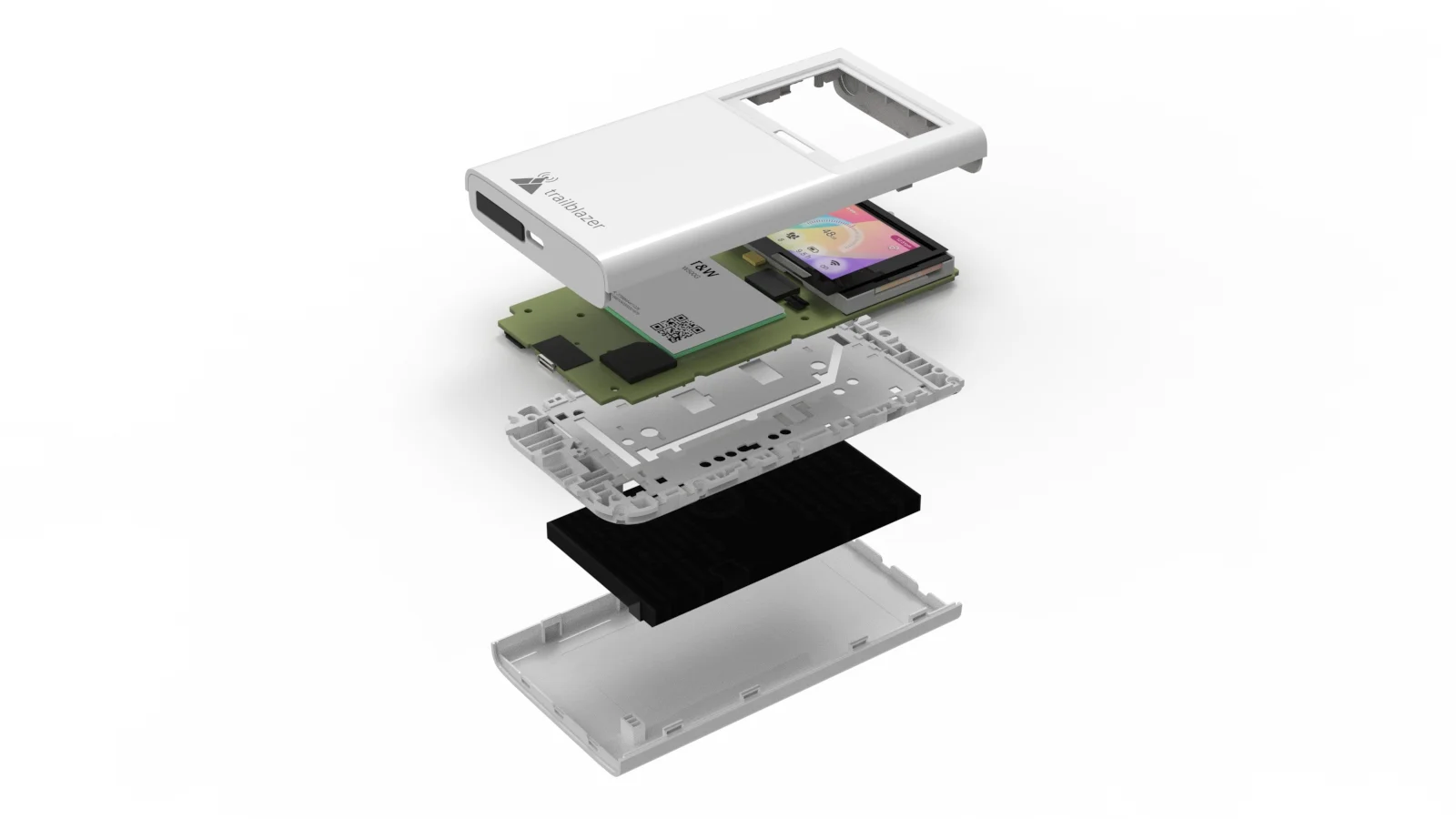
The tall, vertical body reads like a compact radio, gripped in the palm with the screen facing up. The slim, wide body reads like a wallet, meant to sit flat in a pocket or bag rather than be held. Both were modelled around the exact same internal components (the same screen, the same connectivity module, the same battery) so the comparison was purely about which silhouette actually serves the device, not two unrelated concepts competing on looks alone.
Every layer, componentised
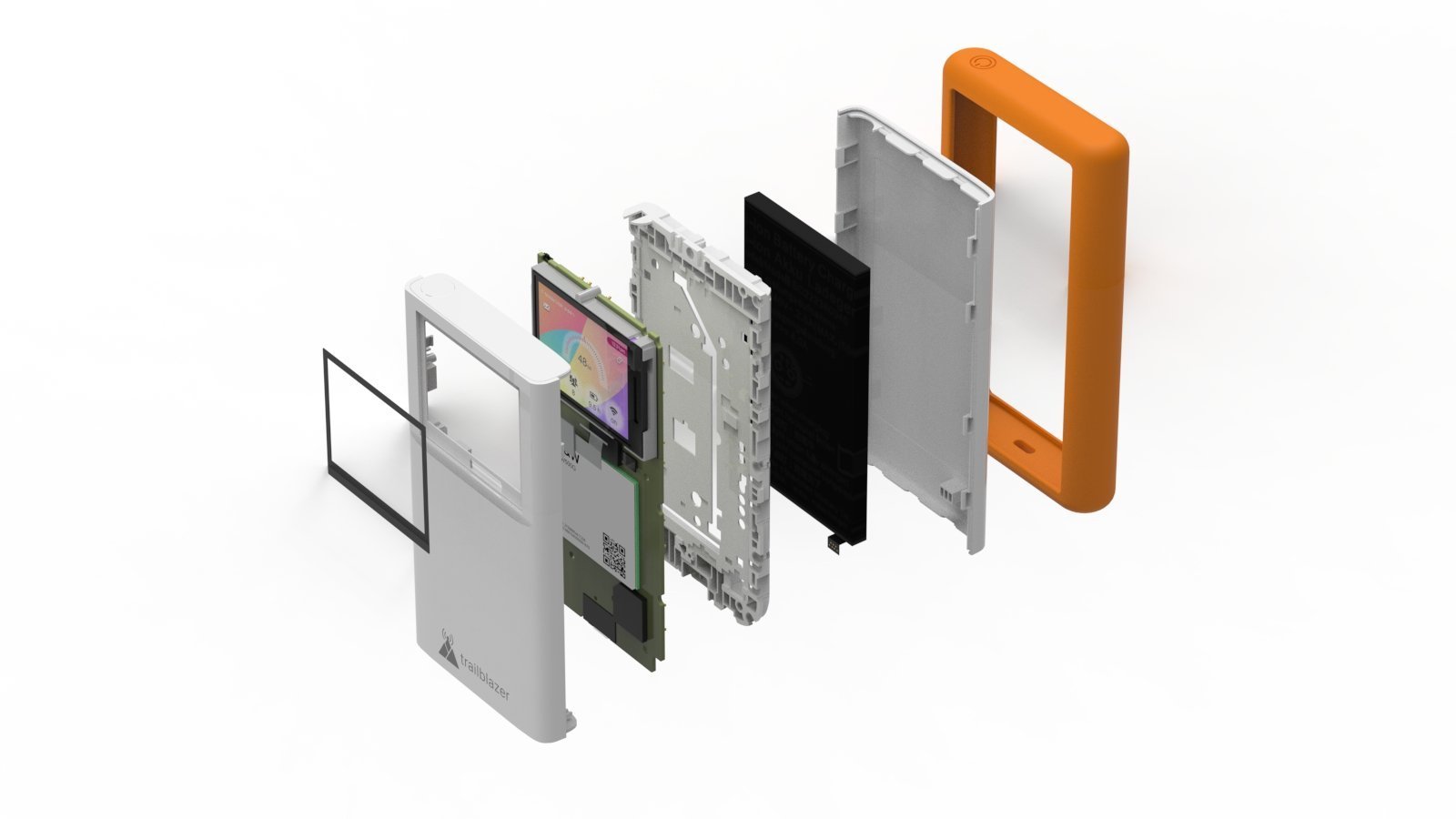
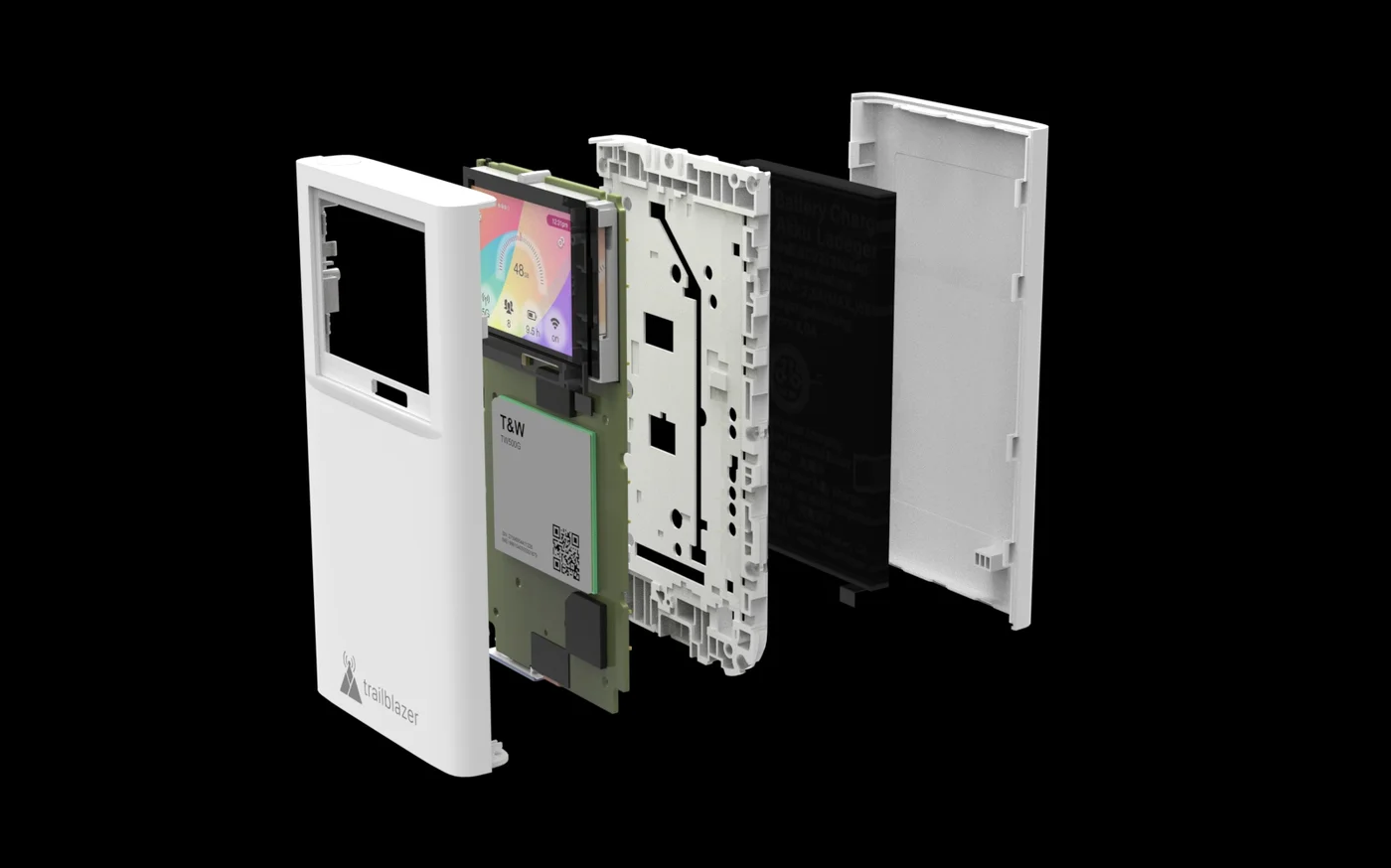
The final stack resolves front to back: a glass lens over the status screen, the front housing, the display itself, the connectivity PCB module (built around a purchased cellular/wifi module rather than a custom board, the right call for a device that doesn't need to reinvent its own radio hardware), an internal mounting frame, the battery, and the back cover. Modelling every layer as a real, fitted component, not just a hollow shell, is what makes the difference between a render and a file a manufacturer can actually assemble.
The silicone bumper was designed alongside the housing, not added afterward: it wraps the case's exact silhouette rather than reading as a generic rubber sleeve bought off a parts catalogue, which is the difference between a protective accessory that looks like it belongs to the product and one that looks like an accessory.
The bumper is part of the design, not an add-on
- Rectangular loop cutout for a wrist strap or carabiner, built into the bumper's own geometry
- Wraps the exact silhouette of the housing rather than a generic universal sleeve
- Designed and modelled in the same pass as the housing, not fitted after the fact
How we work on connectivity hardware
A device like Trailblazer lives or dies on componentisation: every internal part has to actually fit, actually mount, and actually survive assembly, not just look plausible in a render. We modelled the full stack around the real connectivity module being used, not a placeholder block, and treated the protective accessory as part of the same design problem as the housing, not a separate afterthought handed to someone else.
That's the same discipline we bring to any electronics-adjacent product: the design has to survive contact with the actual components inside it, not just the marketing photo.
Outcome
Trailblazer is a fully componentised design: two form factors modelled and compared around identical internal hardware, every layer from front lens to back cover resolved as a real fitted part, and a dedicated silicone bumper designed alongside the housing rather than bolted on after, ready to hand to a manufacturer.
What's inside the design
Design
- Two form factors modelled and compared, pocket-radio vs. wallet-style
- Dedicated status screen for signal, battery and connected devices
- Silicone bumper designed as part of the housing, not after it
Engineering
- Full internal stack modelled as real, fitted components
- Housing built around an actual connectivity PCB module
- Mounting frame and back cover resolved for real assembly
Process
- Two competing form factors compared on identical hardware
- Every layer of the stack modelled front to back
- Protective accessory designed in the same pass as the housing
Questions About Trailblazer
Trailblazer is a pocket-sized wifi hotspot with its own status display, resolved from two competing form factors into a fully componentised, manufacturer-ready design.
A tall, pocket-radio-style body and a slim, wide, wallet-style body carry the same internal stack very differently in the hand. Comparing both against the same components made the tradeoff between grip and pocketability an explicit design decision, not a default.
Coffer Studios modelled the full internal stack (screen, PCB module, mounting frame, battery and back cover) around the connectivity module actually being used, resolved the housing into two comparable form factors, and designed a dedicated silicone bumper as a real accessory rather than an afterthought.
It was designed alongside the housing from the start, not bolted on afterward, which is why it wraps the exact silhouette of the case rather than reading as a generic rubber sleeve.
More from the studio
Related reading
The Prototype Mistake That Costs Founders $20,000 (And How to Avoid It)
The most expensive prototyping mistake isn't skipping a prototype, it's prototyping in a way that doesn't match production. Here's how to avoid it.
Draft Angle: The 2° Rule That Decides Whether Your Injection-Molded Part Ships or Sticks
1 to 2 degrees is where to start, not where to stop checking. Here's what actually changes the number.
Have A Product Like This?
We respond to every serious enquiry within one business day.